Healthcare SEO results from selected private healthcare projects
The selected projects below recorded Organic Search session growth of 231.9%, 269.5% and 568.5% during the measured comparison periods.
The projects below are selected examples of work delivered by the same team now behind Chairside Marketing while working in previous healthcare marketing roles. The team created and migrated the featured websites from their previous versions, then led the organic search strategies that followed. Client names, domains and identifying details have been removed for confidentiality.
View the results belowSelected healthcare SEO results
Source: Google Analytics
Results context
Created and migrated
Every featured website
231.9% to 568.5%
Organic session growth recorded
46,000
Organic Search sessions in the strongest case
38,000
New users acquired through Organic Search
These were not established websites that the team simply took over and optimised. Each website was created and migrated from an older version before the ongoing SEO strategy was implemented.
The work focused on identifying the markets, services and searches with genuine commercial value, then strengthening the relationship between informational content, treatment pages and the patient journey. Priorities were reviewed using Google Analytics, Google Search Console, Ahrefs and Screaming Frog.
Case study 1
Growing two healthcare websites across different markets
One private healthcare provider operated separate websites for its international audience and its Belgian market. The team created and migrated both websites from their previous versions, then developed a different organic search strategy for each market.
The websites required different approaches, but both needed a clearer relationship between priority markets, commercial pages and supporting content.
One healthcare organisation, two websites and two distinct market strategies.
International website
22,670
Organic Search sessions
+231.9%
Increase recorded in Google Analytics
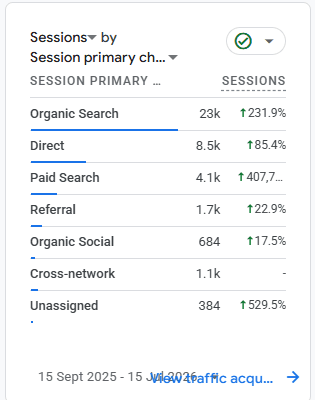
Google Analytics recorded 22,670 sessions from Organic Search during the selected measurement period, compared with 6,830 in the comparison period.
Measurement period: 15 September 2025 to 15 July 2026
9,720
Google organic clicks in the latest three months
+49.8%
Compared with the preceding three months
Google Search Console recorded 9,720 organic clicks in the latest three-month period, compared with 6,490 in the preceding three months. Impressions increased from approximately 930,000 to 1.13 million.
Belgian website
29,000
Organic Search sessions
+269.5%
Increase recorded in Google Analytics
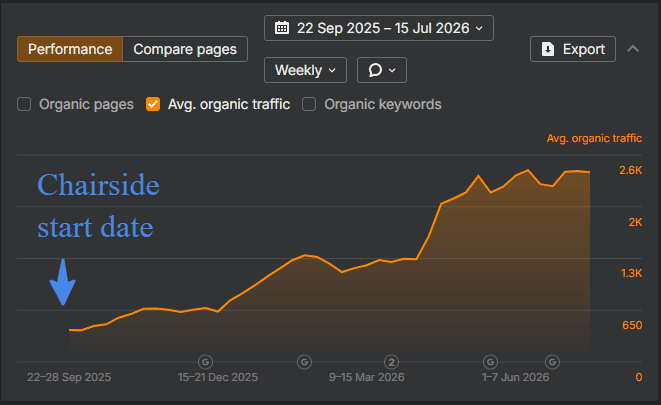
The market-specific website generated approximately 29,000 Organic Search sessions during the selected measurement period, an increase of 269.5%.
Measurement period: 15 September 2025 to 15 July 2026
26.7 to 12.1
Average Google position
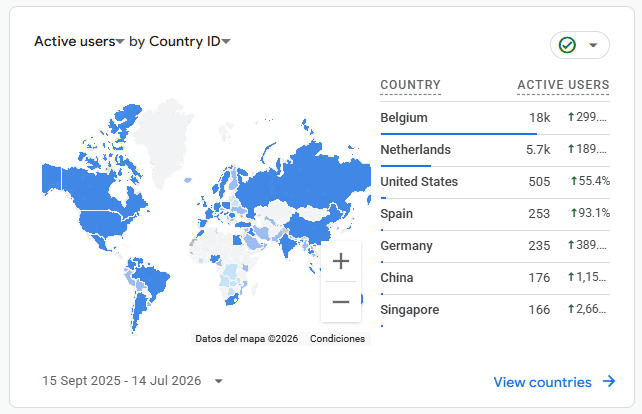
Belgium
Leading market by active users
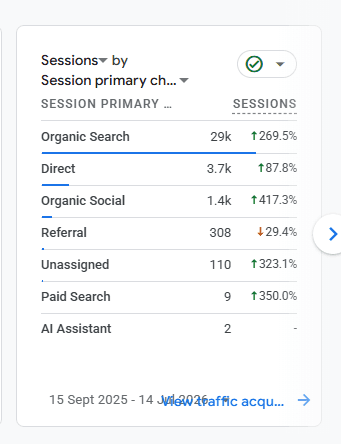
Google Search Console showed average position improving from 26.7 to 12.1 across the displayed comparison.
The challenge
The international website targeted several countries and a wide range of topics without a sufficiently clear hierarchy between priority markets, commercial services and informational content.
The Belgian website required a more focused market strategy. Its pages needed to better reflect the language, search behaviour and treatment questions relevant to users in Belgium and the Netherlands.
Across both websites, the strategy needed to become more selective. The objective was to strengthen visibility where the organisation had a clear patient proposition while reducing competition between closely related pages.
What the team changed
- 01
Website creation and migration
The team created both websites and managed their migration from the previous versions, establishing a stronger structure for future organic growth.
- 02
Prioritised the strongest markets
Keyword research, content planning and page priorities were reorganised around the markets with the clearest commercial opportunity.
- 03
Strengthened commercial pages
Important treatment and market pages were improved so their purpose, search intent and relationship with supporting content were clearer.
- 04
Reduced overlap and improved internal linking
Closely related pages were consolidated or repositioned where necessary, while supporting content was connected more deliberately to priority commercial pages.
The team’s role
The team now behind Chairside Marketing led the SEO diagnosis, market prioritisation, keyword and content strategy, website structure decisions and implementation priorities. Delivery was coordinated with content, development and clinical review specialists, followed by ongoing refinement using performance data.
What this case study demonstrates
The growth did not come from applying an identical strategy to two domains. Each website was given a clearer purpose, market focus and content structure. The common principle was to concentrate authority around the searches, services and locations most relevant to prospective patients.
Case study 2
Making Organic Search the primary growth channel
For this private healthcare provider, the team created and migrated a new website from its previous version, then led the ongoing organic search programme. Paid search and other acquisition channels were managed separately.
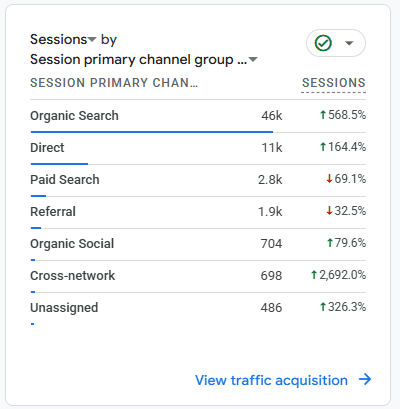
46,000
Organic Search sessions
+568.5%
Increase recorded in Google Analytics
Google Analytics recorded approximately 46,000 Organic Search sessions during the selected comparison, an increase of 568.5%.
Measurement period: 15 September 2025 to 15 July 2026
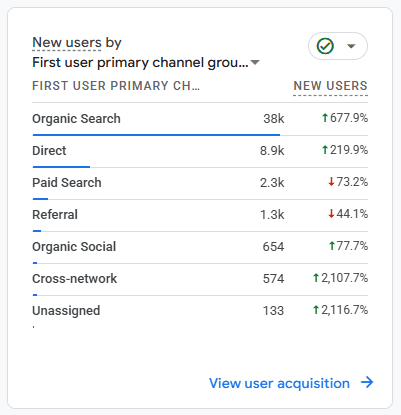
38,000
New users from Organic Search
+677.9%
Increase recorded in Google Analytics
Organic Search introduced approximately 38,000 new users during the same measured period, an increase of 677.9%.
Measurement period: 15 September 2025 to 15 July 2026
Growth was not driven by increased paid search activity
Paid Search sessions declined by 69.1% during the same Google Analytics comparison in which Organic Search sessions increased by 568.5%. This does not prove that every increase was caused solely by SEO, but it shows that the website’s growth was not supported by an increase in paid search traffic.
The challenge
The previous website had significant room to improve its structure and visibility for non-branded healthcare searches. The project required more than ongoing content production. It involved creating and migrating a new website, establishing a stronger organic search foundation and then developing its visibility over time.
The objective was to attract more relevant users through Organic Search without depending on increased paid search activity.
How the website and organic programme were developed
The work began with the creation and migration of a new website, followed by an ongoing organic search programme. Priorities were set using first-party search and analytics data, then reviewed and adjusted as rankings, traffic and user acquisition changed.
- Website creation and migration
- Organic search strategy
- Research and content prioritisation
- Ongoing performance review
The team’s role
The team now behind Chairside Marketing led the organic search strategy, research, prioritisation and ongoing performance review, working with the wider content and website teams responsible for implementation.
What this case study demonstrates
Organic Search became the website’s strongest source of sessions and new users during the measured period. The result was visible in first-party Google Analytics data and was not dependent on an increase in paid search activity.
Organic growth was accompanied by more enquiries
Enquiry volumes also increased substantially across the websites during the measurement period. Because historical conversion tracking was not consistent enough to support a reliable numerical comparison, no enquiry-growth percentage has been published.
What the work involved
The results came from making clearer strategic decisions about where each website should compete, which pages mattered most and how supporting content contributed to the patient journey.
Website creation and safe migration
The team created each featured website and managed its migration from the previous version, with continuity of organic visibility treated as a core requirement throughout the transition.
- 02
Market and service prioritisation
Identifying the locations, services and search intentions with the greatest commercial relevance.
- 03
Commercial page strategy
Giving the most important treatment and market pages a clearer role within each website.
- 04
Content consolidation
Reducing overlap where multiple pages competed for closely related searches.
- 05
Ongoing optimisation
Using first-party performance data to adjust priorities rather than treating SEO as a fixed publishing plan.
What these results mean for dental practices
The same problems appear repeatedly on dental websites: several treatment pages competing for similar searches, location pages with little genuine local relevance, blogs generating traffic without supporting treatment pages and commercially important services buried inside weak website structures.
- 01
Give priority treatments one clear primary page
Implants, Invisalign, cosmetic dentistry and other important services should have clear primary pages rather than several overlapping alternatives.
- 02
Connect informational content to the treatment journey
Blogs and guides should answer real patient questions while strengthening the relevant treatment pages.
- 03
Focus local visibility on genuine opportunities
Location targeting should reflect the areas the practice actually serves and the treatments it is equipped to provide.
Clicks, sessions and rankings are useful indicators, but dental marketing should ultimately connect search visibility with calls, forms, consultations and patient enquiries.
How the results were measured
Google Analytics session and user figures are first-party website analytics data. Google Search Console reports performance within Google Search. Ahrefs provides third-party estimates that may differ from actual website traffic.
The main measurement period shown across the case studies is 15 September 2025 to 15 July 2026.
The websites also generated substantially more enquiries during this period. However, historical conversion tracking was not consistent enough to support a reliable percentage comparison, so enquiry growth has not been presented as a quantified result.
The screenshots have been anonymised. Client names, domains and identifying details have been removed for confidentiality.
These case studies report organic traffic and search visibility. Precise conversion-growth figures have not been included because event definitions and historical conversion tracking were not consistent throughout the measurement periods.
Could your dental website be generating more patient enquiries?
We will review your treatment pages, local visibility, website structure, search performance and enquiry tracking to identify where growth is being lost.