A dental website can look impressive and still do very little for the practice.
It may hide important treatments several clicks deep, load slowly or attract traffic without generating the kinds of enquiries the practice actually wants. Dental website SEO helps search engines understand what you offer, where you are based and which page should appear for each treatment search.
This guide covers the main areas a UK dental practice should review, from treatment pages and technical performance to Google Business Profile optimisation. It also includes a practical checklist you can use to spot obvious weaknesses.
In simple terms: good dental website SEO makes it easier for the right local patients to find the right page, understand the treatment and take the next step.
What Is Dental Website SEO?
Dental website SEO is the process of improving a dental practice website so it can appear more prominently in unpaid search results.
The goal is not simply to attract more visitors. A practice needs relevant visitors: people in the right area, searching for treatments the practice genuinely offers and with a reasonable chance of becoming patients.
For example, someone searching for “dental implants in Bristol” should ideally land on a useful implant page for a Bristol practice. They should not arrive on a generic homepage containing one sentence about implants among a long list of other treatments.
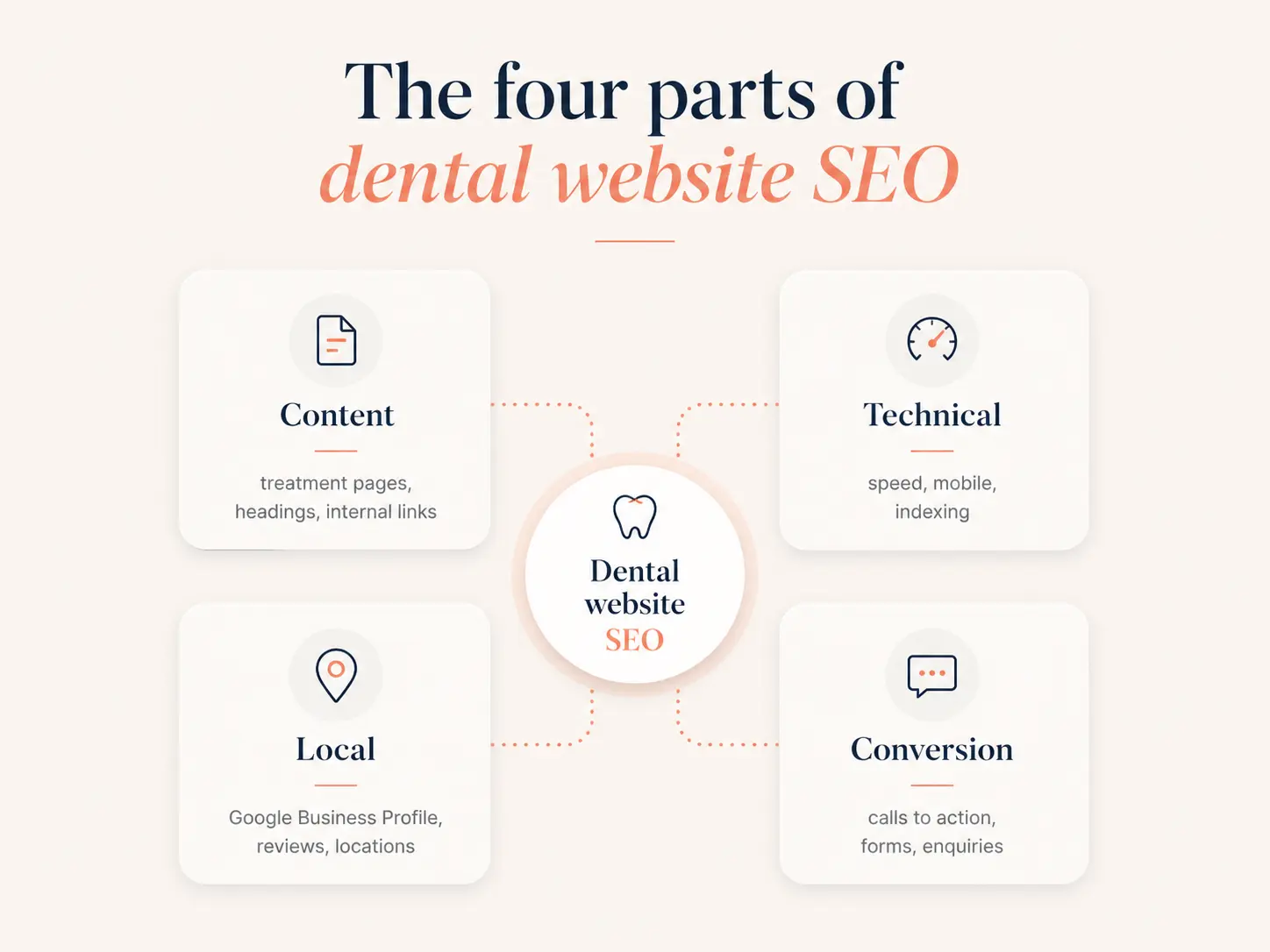
A complete dental SEO strategy normally includes four connected areas:
Website structure: making treatments, clinicians, locations and patient information easy to find.
On-page SEO: improving the content, headings, titles, images and internal links on each page.
Technical SEO: ensuring search engines can crawl and index the site without unnecessary problems.
Local SEO: strengthening the relationship between the website, Google Business Profile and the area the practice serves.
For UK practices, content also needs to be accurate and professionally responsible. Credentials should be current, treatment claims should not mislead patients and website information should follow the GDC’s guidance on advertising.
SEO cannot rescue a confusing website on its own. Visibility gets a potential patient through the door. The website still has to build trust and make it easy to enquire.
What Does a High-Performing Dental Website Need?
A high-performing dental website does three jobs well: it helps patients find information, gives them confidence in the practice and makes contacting the team straightforward.
That starts with structure.
Important treatments should have their own pages rather than being squeezed into one general services page. If implants, Invisalign, composite bonding or emergency care are priorities for the practice, each deserves enough space to answer the main questions a patient will have.
The navigation should also reflect how patients think. Most people are not looking for “clinical solutions” or “advanced smile options”. They are looking for a dentist, a treatment, a fee, an appointment or reassurance about what happens next.
A useful dental website makes treatments, fees, team information, emergency appointments, location details and booking options easy to find. Team pages should explain who provides each treatment, with accurate qualifications and professional details. Original photographs are usually more helpful than generic stock images because they show patients what to expect.
Calls to action should also be obvious. A patient should not have to reach the footer to find a telephone number or complete a long form just to request a callback.
Does the website need to be bespoke?
Not necessarily.
A bespoke dental website is not automatically better for SEO, and a template is not automatically poor. What matters is whether the site can be edited, expanded, kept fast and structured around the practice’s actual services. It should support proper treatment pages, internal links, team updates and enquiry tracking without making every change unnecessarily difficult.
For practices reviewing a rebuild, our dental website design service explains how design, SEO and conversion should work together from the start.
On-Page SEO for Dental Websites
On-page SEO covers the parts of each page that you can directly improve.
The most important decision is what each page is actually for.
Your homepage may target the practice name, its main location and a broad dentist-related search. A dental implant page should focus on implant treatment. An emergency page should serve someone looking for urgent help. Trying to make every page rank for every treatment usually creates vague content and several pages competing for the same searches.
Create useful treatment pages
A strong treatment page should help a patient understand the service and decide whether to contact the practice.
Depending on the treatment, it may need to explain:
What the treatment involves
Who it may be suitable for
What happens during an assessment
The main stages of treatment
Benefits, limitations and alternatives
Fees or factors that affect cost
Which clinician provides it
How to arrange an appointment
This is where many dental websites fall short. They include a short definition of the treatment, a few generic benefits and a contact button, but little that helps the patient make a decision.
The content does not need to become a clinical textbook. It should answer the questions reception hears every week and give enough detail for the patient to understand the next step.
Use location terms naturally
Location is important, but repeating “dentist in [town]” throughout the page will not make weak content useful.
A page can establish local relevance through the practice address, the areas it serves, travel information, local contact details and clear references to where consultations and treatment take place.
Be careful with location pages. Creating twenty nearly identical pages for surrounding towns is unlikely to help if the only change is the place name. A location page should contain genuinely useful local information.
For a deeper look at this part of the strategy, see our guide to local SEO for dentists.
Write clear titles and descriptions
Each important page needs a unique title that reflects its purpose. Dental Implants in Bristol | Practice Name is clearer than a title crammed with every variation of implants, dentists and locations.
Meta descriptions should briefly summarise what the page offers rather than repeat a list of keywords.
Use headings to make pages easier to scan
Patients rarely read treatment pages from top to bottom. They look for the part that answers their immediate question.
Helpful headings might include:
What are dental implants?
Am I suitable for treatment?
What happens during the process?
How much does treatment cost?
Who provides the treatment?
Clear headings help patients, and they also make the subject of the page easier for search engines to understand. Google’s own SEO Starter Guide provides further guidance on structuring content so that both search engines and users can understand it.
Add internal links where they are genuinely useful
Internal links connect related information across the site. An implant page might link to the clinician, fees, sedation options and consultation page.
Use anchor text that describes the destination. “View our dental implant fees” is more useful than “click here”.
Keep clinical and promotional claims under control
Dental content should be persuasive without making promises it cannot support.
Phrases such as “pain-free”, “guaranteed results”, “the best dentist” or “permanent solution” need careful review. The same applies to before-and-after photographs and testimonials, which should not imply that every patient will achieve the same outcome.
Clear, balanced wording usually builds more trust than exaggerated marketing language.
Free website audit
Not sure how your dental website SEO is performing?
Get a free review of your dental practice website and see what may be holding back your rankings, local visibility and patient enquiries. We will highlight the key issues, quick wins and next steps in plain English.
Technical SEO: The Essentials
Technical SEO sounds more complicated than it needs to be. For a practice owner, the main question is whether search engines and patients can use the website without running into problems.
Make sure important pages can be indexed
A page cannot rank if Google cannot access or index it.
Common problems include pages accidentally marked as noindex, broken internal links, incorrect canonical tags, staging pages appearing in search and old URLs returning errors after a redesign.
Google Search Console is the main tool for checking how Google sees the website. The URL Inspection tool can show whether an important page is indexed and highlight some of the reasons it may not be.
Check speed and mobile usability
A dental website often becomes slow because of oversized images, video backgrounds, sliders, chat tools or too many plugins.
Use PageSpeed Insights to identify obvious issues, but do not obsess over a perfect score. Test the full mobile journey instead: can a patient read the page, tap the telephone number, complete the form and find directions without fighting pop-ups?
Keep the site secure and clean
The website should use HTTPS throughout, forms should submit securely and broken links should be repaired.
The XML sitemap should contain the pages you actually want search engines to find, not redirected URLs, error pages or old test content.
Website rebuilds need particular care. Changing design without mapping old URLs to their new equivalents can wipe out years of accumulated visibility. Redirects, titles, content and tracking should all be checked before and after launch.
Local SEO for Dentists
For most dental practices, local SEO is where website optimisation and Google Business Profile meet.
A strong profile helps the practice appear in local search results and on Google Maps. It also gives patients immediate access to information such as reviews, opening hours, photographs and contact details. According to Google’s guidance on improving local rankings, local results are mainly influenced by relevance, distance and prominence. Complete business information, current opening hours, reviews and photographs can all help Google and prospective patients understand the practice.
Start with the basics:
Make sure the practice controls and has verified the profile.
Use the genuine practice name rather than adding extra treatments or locations.
Keep the address, phone number, website and opening hours accurate.
Select the most appropriate business categories.
Add the treatments the practice genuinely provides.
Upload current photographs of the building, team and facilities.
Ask for reviews consistently and respond professionally.
The profile should match the website and other important listings.
Reviews also need careful handling. Responses should remain professional and should not reveal or confirm confidential patient information. If collecting reviews consistently is a challenge, Chairside Marketing can build a simple review-request system for your practice, helping your team ask for feedback at the right time without adding unnecessary admin.
For multi-location groups, each genuine practice location should have its own useful website page and corresponding Google Business Profile. A copied page with only the town name changed adds very little value.
Dental Website SEO Checklist
Use this checklist to identify the most obvious gaps. Fix critical issues first rather than trying to improve everything at once.
Website and content
Priority treatments have dedicated pages
Each page has a clear purpose
Titles and meta descriptions are unique
Content answers genuine patient questions
Team and qualification details are current
Treatment claims are balanced and supportable
Contact details are easy to find
Important pages link to related information
Location terms are used naturally
Similar pages are not competing for the same search
Technical SEO
Important pages can be indexed
The website uses HTTPS
Forms and phone links work on mobile
Large images are compressed
Broken links and error pages are fixed
The XML sitemap is current
Search Console and Analytics are installed
Old URLs redirect to relevant replacements
Local SEO
Google Business Profile is verified
Name, address and phone number match the website
Categories and services are accurate
Opening hours are current
Practice photographs are up to date
Reviews are requested consistently
Reviews receive appropriate responses
Each genuine location has a useful page
Trust and enquiries
Patients can see who provides each treatment
Fees or pricing factors are explained where appropriate
The next step is clear on every priority page
Enquiry forms are short and tested
Calls and forms are being tracked
The practice follows up enquiries promptly
Maintaining and Tracking Dental Website SEO
SEO is not finished when a page is published. Treatments, clinicians, fees and competitors change, so important pages need occasional review.
Google Search Console should be checked regularly for changes in clicks, impressions, queries and landing pages. Look beyond total traffic. The important question is whether the website is becoming more visible for the treatments and locations that matter to the practice.
Traffic also needs to be connected to enquiries. Track calls, forms and online bookings where possible. A rise in website visits is not especially valuable if the visitors are landing on irrelevant blog posts or the practice never responds to their enquiries.
There is no guaranteed SEO timeframe. Some technical fixes may have an effect relatively quickly, while meaningful growth for competitive treatment searches can take months. The starting condition of the website, local competition, authority and consistency of implementation all matter.
Review progress through trends rather than promises. Are the right pages gaining visibility? Are more patients finding priority treatments? Are enquiries improving? Those are better measures than chasing a single ranking. You can see how we measure organic growth in our healthcare SEO case studies, including the reporting methods and limitations behind the results.
For a clearer idea of typical budgets and what different services may include, read our guide to dental SEO costs in the UK. Our dental SEO service for dental practices brings together treatment-page optimisation, technical SEO, local visibility and enquiry tracking.
Request a Free Dental Website Audit
Good dental website SEO is not about adding a town name to every page or publishing blog posts simply to keep the site active.
It requires useful treatment content, a clear structure, sound technical foundations and accurate local information. Most importantly, it needs to connect search visibility with real patient enquiries.
Start with the checklist above and fix the most important issues first.
For a more detailed review, request a free dental marketing audit. We will assess your website, local visibility, priority treatment pages and enquiry journey, then show you what is working and what should be addressed next.