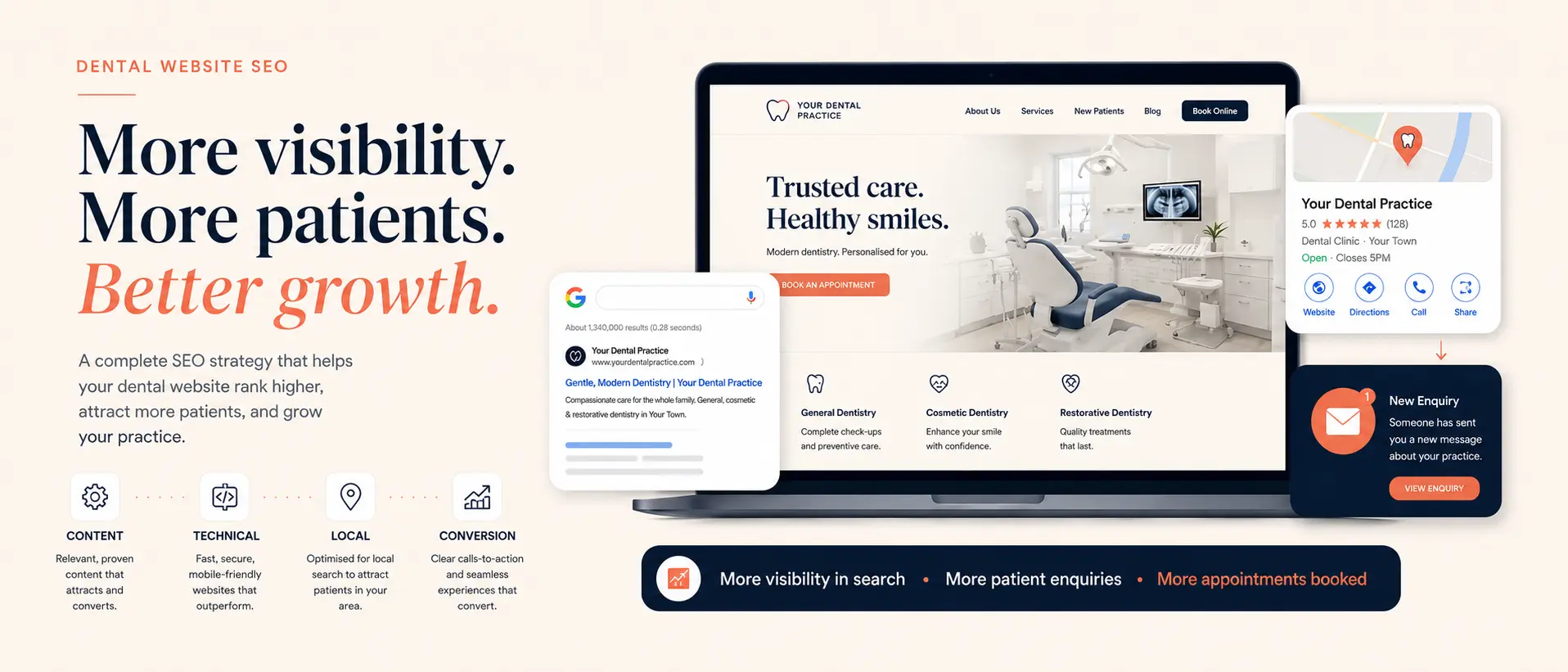
There is no shortage of dental marketing ideas.
SEO, Google Ads, Instagram, reviews, email marketing, video, Google Business Profile and referral campaigns can all play a part.
The harder question is: which ones should your practice actually prioritise?
A new private practice trying to fill its diary has a very different marketing problem from an established NHS-heavy practice with more demand than capacity. Likewise, a practice wanting more implant patients should not necessarily use the same strategy as one trying to increase routine new patient registrations.
So rather than giving you another list of disconnected tactics, this guide looks at the main dental marketing ideas available to UK practices, what each one is useful for and how to decide where to start.
What is dental marketing?
Dental marketing is everything your practice does to help the right patients find you, trust you, choose you and continue coming back.
Advertising is part of it, but only one part.
Your website is marketing. Your Google reviews are marketing. Your visibility when somebody searches for a dentist locally is marketing. So are your patient communications, treatment pages, social media activity and the experience somebody has when they first contacts reception.
Having worked clinically in dentistry before moving into marketing, I think practices can sometimes make marketing more complicated than it needs to be.
Good dental marketing should not be about persuading patients to buy treatment they do not need. At its best, it helps people understand their options, gives them confidence in the practice and makes it easier to take an appropriate next step.
Most dental marketing activity supports one or more of these goals:
- attracting new patients
- generating demand for particular treatments
- improving local visibility
- retaining or reactivating existing patients
- strengthening trust and reputation
Knowing which of these matters most should come before choosing a marketing channel.
Start with the goal, not the tactic
One of the easiest ways to waste money is to begin with:
"We should probably be doing more Instagram."
Or:
"Maybe we need Google Ads."
Instead, start with the problem.
What do you actually want more of?
Perhaps general dentistry is busy, but you want to increase implant cases.
Maybe you have spare hygiene capacity.
Perhaps you have recently opened and need new patients quickly.
Or maybe enquiries are already arriving, but too few turn into appointments.
Those are different marketing problems.
Who are you trying to reach?
Patient behaviour also varies by treatment.
Someone researching dental implants may compare clinicians, websites, reviews, finance options and treatment approaches for weeks before contacting a practice.
Someone searching for an emergency dentist with severe toothache may decide within minutes.
The marketing required for those two journeys is not the same.
What is currently holding growth back?
This is often the most useful question.
There is little point paying for more website visitors if the site does not convert them.
Likewise, rebuilding an already effective website will not solve the problem if your practice barely appears in local search.
Find the bottleneck first.
1. Make your dental website work harder
Nearly every digital marketing channel eventually leads back to your website.
Before investing heavily in more traffic, make sure the site gives prospective patients what they need to take the next step.
A dental website should make it easy to understand:
- what treatments you provide
- who provides them
- where the practice is
- whether you are NHS, private or mixed
- what makes the practice different
- what treatment may cost
- how to contact or book with you
Important treatment pages should also go beyond a short description.
A patient considering implants, orthodontics or cosmetic dentistry may want to understand candidacy, alternatives, the treatment process, risks, recovery, costs and likely timelines.
The objective is not simply to rank in Google.
It is to help somebody move from:
"I'm researching treatment"
to:
"This looks like a practice I could trust."
If your website is old, slow or difficult to use, improving your dental website design can make every other marketing channel work harder.
If you are considering a larger rebuild, it is also worth understanding how much a dental website costs in the UK before deciding what level of investment makes commercial sense.
2. Improve your Google Business Profile and local visibility
For many dental searches, Google effectively acts as a local directory.
If somebody searches for a dentist, hygienist or emergency appointment nearby, your Google Business Profile can be one of the first things they see.
Keep your contact details, opening hours, categories, services and photographs accurate and useful. Google requires businesses to represent themselves accurately and consistently on their profiles.
For the official requirements, see Google's Business Profile guidelines.
Reviews matter too.
Instead of asking for them occasionally, build review requests into a repeatable patient journey.
You might ask appropriate patients after treatment or provide a simple review link in a follow-up communication.
What you should not do is offer discounts, prizes or free services in exchange for positive reviews. Google prohibits incentivised reviews and other forms of fake engagement.
See Google's guidance on prohibited and restricted content.
Your Business Profile should form part of a broader local SEO strategy for dentists, rather than being optimised in isolation.
3. Use dental SEO for sustainable visibility
Dental SEO is about making your practice visible when prospective patients search organically for the services you provide.
That could include searches around:
- dentists in your town
- emergency dentistry
- dental implants
- Invisalign or orthodontics
- cosmetic dentistry
- hygienist appointments
- treatment costs
- common dental questions
SEO usually makes the most sense when you want to build visibility over the longer term.
A strong dental SEO strategy normally combines:
Commercial service pages.
Pages covering the treatments that matter commercially.
Local SEO.
Signals that help search engines understand where the practice operates.
Educational content.
Useful resources answering the questions patients research before making contact.
Technical SEO.
Making sure the website is fast, crawlable and understandable to search engines.
Authority building.
Relevant mentions and links that strengthen the credibility of the website.
SEO is not instant. But unlike paid advertising, you are building an asset that can continue generating visibility without paying for every individual click.
4. Use Google Ads when you need demand sooner
SEO and Google Ads solve related problems at different speeds.
Google Ads can put your practice in front of somebody already searching for a dentist or a particular treatment.
That can make paid search useful when:
- you are opening a new practice
- you need to fill spare capacity
- you are launching a specific treatment
- organic visibility is still weak
- you need enquiries sooner
The trade-off is simple.
SEO builds visibility over time.
Paid search can generate visibility almost immediately, but you continue paying for the traffic.
The two are not mutually exclusive.
A practice might use Google Ads for dentists to generate short-term demand while building stronger organic visibility through SEO.
The important thing is what happens after the click.
Someone searching specifically for dental implants should usually land on a strong implant page, not a generic homepage that forces them to start searching again.
5. Create content around questions patients actually ask
Dental professionals already have a valuable source of content ideas: patients.
Think about the questions you hear repeatedly:
- How painful are dental implants?
- Can I have Invisalign if I already have crowns?
- Why do my gums bleed?
- How long does whitening last?
- What happens if I am nervous about treatment?
- How long does implant treatment take?
Those questions can become treatment-page content, FAQs, articles and videos.
Good content sits between clinical expertise and marketing.
It answers a genuine patient question while helping that person understand their options and when they may need professional advice.
Avoid publishing an article simply because an SEO tool says a keyword exists.
A page should exist because it answers something useful.
Free Dental Marketing Audit
Not sure what your practice should prioritise?
We’ll review your website, SEO, local visibility and paid search to identify where you may be losing opportunities and what is worth focusing on next.
6. Use social media to build familiarity and trust
Social media is often treated as if every dental practice needs to become a media company.
It does not.
Most patients are unlikely to be scrolling through Instagram actively looking to buy dental treatment.
Social media can, however, be useful during the trust-building phase.
A prospective patient may discover your practice through Google and then check Instagram before making contact.
Useful content might include:
- clinician and team introductions
- short treatment explanations
- common patient questions
- practice updates
- oral health advice
- explanations of what happens during consultations
- appropriate treatment examples where advertising rules permit them
Video can be particularly useful.
Hearing a clinician clearly explain what happens during an implant consultation can build more trust than another polished graphic telling someone to "transform their smile".
7. Market to the patients you already have
Dental marketing is often treated entirely as patient acquisition.
That overlooks the patient base you have already built.
Depending on the practice, opportunities might include:
- improving recall processes
- reactivating genuinely lapsed patients
- following up appropriate treatment plans
- making patients aware of relevant services
- improving enquiry follow-up
- encouraging recommendations
- improving communication throughout the patient journey
Email and SMS can help, but dental practices need to distinguish ordinary patient communications from direct marketing.
The ICO provides detailed guidance on electronic marketing under UK GDPR and PECR, including when consent may be required and when the limited soft opt-in may apply.
See the ICO's guidance on electronic mail marketing.
Do not simply export your entire patient database and start sending promotional messages because the software makes it possible.
8. Treat high-value treatments differently
Someone looking for a check-up is making a relatively straightforward decision.
A patient considering implants, orthodontics or significant cosmetic treatment may have:
- greater concerns about cost
- more questions about risks
- anxiety about treatment
- multiple practices to compare
- a much longer decision-making process
Marketing for higher-value dentistry therefore needs more than simply generating the initial click.
Strong treatment pages, clinician credibility, reviews, educational content, effective follow-up and a clear consultation process all become more important.
The objective is not simply visibility.
It is reducing uncertainty sufficiently for the right patient to feel comfortable making an enquiry.
9. Follow UK dental advertising rules
UK dental practices operate within advertising and professional standards that many generic marketing guides ignore.
The General Dental Council states that dental advertising must be accurate and not misleading. Practice publicity should also make clear whether a practice is NHS, mixed or wholly private.
See the GDC's guidance on advertising.
Be particularly careful with claims around professional status, expertise and treatment outcomes.
Cosmetic treatment advertising may require additional care. The ASA and CAP publish guidance around cosmetic interventions and health-related claims.
See the ASA's guidance on cosmetic interventions.
Practices providing botulinum toxin treatment should be especially cautious. Prescription-only medicines cannot be advertised to the general public in the same way as ordinary cosmetic services.
See CAP guidance on advertising botulinum toxin products.
The principle is simple:
Your marketing still needs to meet the same professional standards as the rest of the practice.
NHS and private practices need different priorities
An NHS-heavy practice in an area with substantial patient demand may gain little from aggressively marketing routine appointments.
That does not mean marketing is irrelevant.
Its priorities might instead include:
- strengthening its reputation
- retaining appropriate patients
- communicating available private services
- growing selected treatments
- improving patient experience and reviews
A private practice with spare capacity faces a different problem.
SEO, local visibility, Google Ads and new patient acquisition may deserve considerably more investment.
The marketing channels might be similar.
The priorities are not.
That is why copying another dental practice's strategy rarely works without understanding what that practice is actually trying to achieve.
How should a dental practice prioritise its marketing?
If you are looking at all these dental marketing ideas and wondering where to begin, use this order.
1. Fix conversion problems
Make sure the website, enquiry process and patient journey can convert the demand you already have.
2. Secure local visibility
Optimise your Google Business Profile, reviews and local search presence.
If this is the weak point, start with local SEO for dentists.
3. Capture existing demand
If you want sustainable organic visibility, investigate dental SEO.
If you need enquiries more quickly, Google Ads for dental practices may deserve priority.
4. Improve retention
Look at recalls, patient communications, treatment-plan follow-up and reactivation.
5. Build longer-term trust
Layer in educational content, video, social media and broader brand activity.
You do not need to do everything at once.
Most practices will make more progress doing three things properly than maintaining eight neglected marketing channels.
Measure patients and enquiries, not vanity metrics
Marketing should eventually connect back to something that matters commercially.
Useful measurements might include:
- new patient enquiries
- booked appointments
- enquiry source
- cost per enquiry
- cost per acquired patient
- priority treatment enquiries
- conversion from enquiry to booking
- patient reactivation
Traffic is useful.
Rankings are useful.
Impressions are useful.
But none of them is the final business outcome.
A practice can double its website traffic and still have a marketing problem if the wrong people are visiting or those visitors never become patients.
Common dental marketing mistakes
Trying to do everything at once
Running SEO, PPC, Facebook, Instagram, TikTok, email and video badly is not a strategy.
Choose channels according to the problem you are trying to solve.
Advertising before fixing the website
More traffic will not compensate for unclear treatment pages, a difficult booking process or weak trust signals.
Ignoring existing patients
Growth does not always require another new-patient campaign.
Retention, reactivation and treatment awareness can sometimes be the more logical place to start.
Publishing generic SEO content
Twenty articles that say nothing useful do not necessarily create more authority than one genuinely strong resource.
Tracking traffic instead of patients
If nobody knows which enquiries came from which activity, deciding where to invest becomes guesswork.
Ignoring advertising regulations
Dental marketing exists within a regulated healthcare environment. GDC, ASA/CAP and ICO requirements should be considered during campaign planning, not checked afterwards.
Build a dental marketing system, not a collection of tactics
The strongest dental marketing strategy is rarely the one using the most channels.
It is the one where each part has a clear purpose.
Your website converts interest into enquiries. Your Google Business Profile helps patients find and assess you locally. SEO builds long-term visibility. Google Ads captures immediate demand. Content and social media build trust. Patient communication supports retention.
Start with the result you want.
Identify what is currently preventing you from achieving it.
Then choose the marketing activity most likely to remove that obstacle.
That will usually take you much further than simply searching for the next dental marketing idea.
Not sure what your practice should prioritise?
If you are unsure whether your biggest opportunity sits in your website, SEO, local visibility or paid acquisition, request a free dental marketing audit.
We will look at where your current marketing is strongest, where demand may be leaking and which areas are actually worth prioritising next.