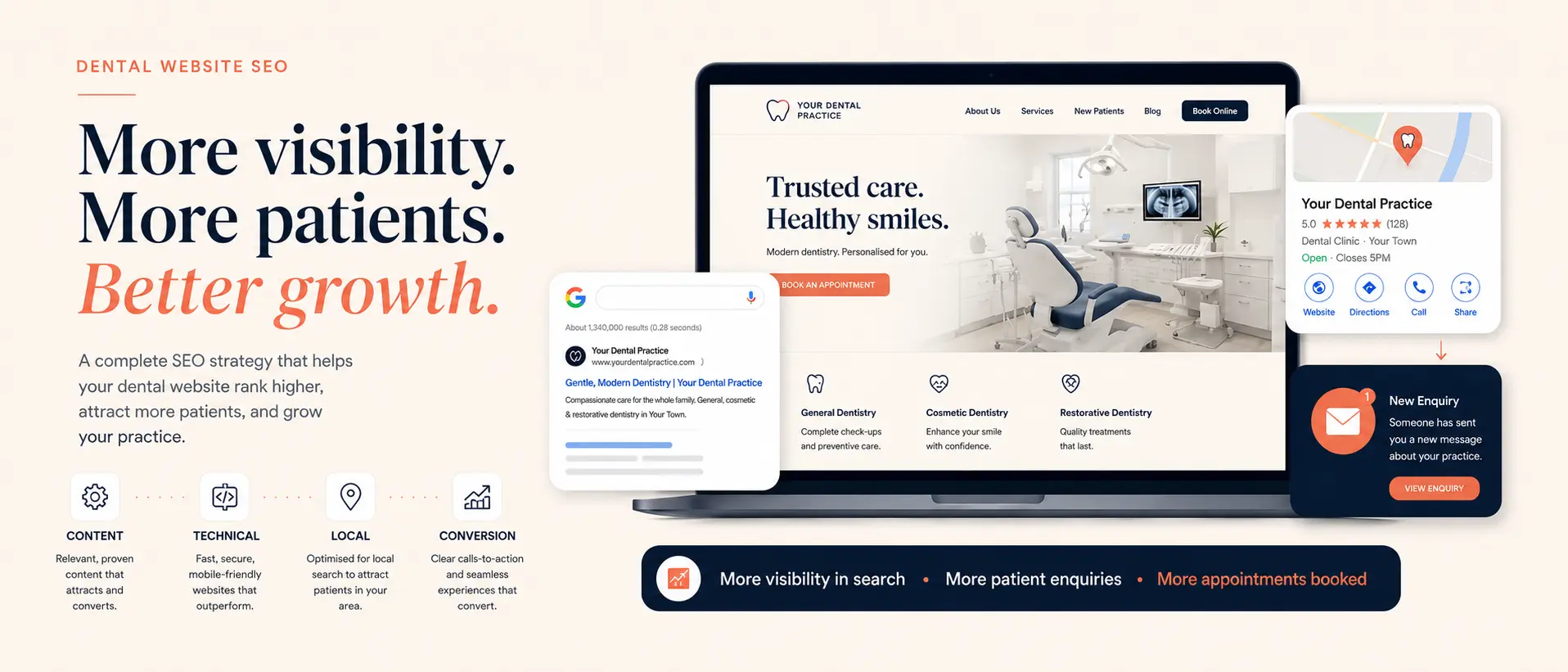
A professionally built dental practice website will often cost several thousand pounds, but there is no reliable single UK average.
At Chairside Marketing, a standard practice website will typically cost between £2,000 and £3,000, depending on the number of pages, content requirements, integrations and the condition of the existing website. Larger content-led, multi-location or technically complex projects may cost more depending on scope.
Across the wider market, published prices vary considerably. At the time of writing in August 2026, advertised UK offers ranged from £349 starter packages to setup fees of £8,950 for broader premium packages.
These are individual providers’ advertised prices, not representative industry averages. They show why practices need to compare what is included rather than judging a proposal by its headline price alone.
The important question is not simply how much the website costs. It is whether the scope is appropriate for the practice and whether the finished site can explain treatments clearly, build patient confidence and generate measurable enquiries.
| Type of project | Typical scope | Important limitations to check |
|---|---|---|
| Starter or template website | A small number of pages built using an existing design framework | Copywriting, SEO, tracking, integrations and ownership may be limited or excluded |
| Standard professional practice website | Customised design, core treatment pages, mobile-friendly enquiry journeys and sound technical foundations | Confirm the exact number of pages, how much content is included and what support is provided after launch |
| Content-led custom website | Bespoke layouts, detailed treatment content, professional photography, tracking and search planning | The price can increase considerably according to the number of treatments, content depth and functionality |
| Complex or multi-location website | Multiple practice locations, extensive content, custom functionality and wider marketing integration | Requires detailed specification, migration planning, location architecture and ongoing management |
These categories describe differences in scope rather than fixed industry price bands. Two proposals that use the same label may still include very different amounts of work.
Why dental website quotes vary so much
Two dental practices can request what sounds like the same thing and receive completely different quotes.
This usually happens because the phrase “new dental website” can describe anything from a pre-built template with a new logo to a bespoke project involving research, copywriting, photography, search optimisation, booking integrations and conversion tracking.
The biggest differences normally come down to the following factors.
Template, semi-custom or bespoke design
A template-led website starts with an existing layout. The designer changes elements such as the colours, fonts, images and content to match the practice.
This can be a sensible option for a new practice with a limited budget and relatively simple requirements. It may become less suitable when the practice needs to differentiate itself in a competitive area or promote several high-value treatments.
A bespoke website takes longer because its structure, page layouts and patient journey are developed around the practice. That additional work increases the price.
However, “bespoke” should not be confused with changing the appearance of an existing theme. Ask the provider exactly which parts of the website will be designed or developed specifically for your practice.
The number and depth of treatment pages
A practice that only needs pages for general dentistry, emergency appointments and contact information requires less work than a multidisciplinary practice promoting implants, orthodontics, cosmetic dentistry, facial aesthetics and specialist services.
Treatment pages should not be treated as interchangeable blocks of text.
A useful dental implant page may need to explain:
- Who treatment may be suitable for
- The stages involved
- Alternative options
- Recovery and aftercare
- Common patient concerns
- Clinician experience
- Indicative costs or finance options
- How to arrange an assessment
Researching, structuring and writing that information properly takes time.
Ten thin treatment pages may be cheaper than five genuinely useful ones, but the cheaper website may do far less to build patient confidence or attract relevant searches.
Copywriting
Some website quotes include professional copywriting. Others expect the practice to supply every word.
This distinction can account for a significant difference in cost.
Writing for a dental website involves more than describing services. The content should answer the questions patients have before contacting the practice, use language they understand and avoid creating unrealistic expectations.
The General Dental Council’s advertising guidance says advertising should be accurate, factual and presented in a way that does not create unjustified expectations.
A copywriter who understands dentistry is more likely to identify the information patients need and explain treatments accurately without making the content sound excessively clinical or impersonal.
Photography and before-and-after images
Professional photography is normally priced separately unless it is explicitly included in the proposal.
A photography package may cover:
- The exterior and reception
- Treatment rooms
- Clinicians and team members
- Patients or models
- Equipment and technology
- Before-and-after cases
- Short-form video
Original photography can make a practice appear more credible than a website built entirely around stock images. However, consent, image quality and the way treatment results are presented all need careful consideration.
The Advertising Standards Authority’s guidance for dental advertising explains that before-and-after images should be genuine, supported by appropriate evidence, used with permission and reasonably representative of the results patients may achieve.
This does not mean every practice needs an expensive photography package. It means photography should be discussed before the quote is accepted rather than discovered as an additional cost halfway through the project.
Booking and practice-management integrations
Adding a basic enquiry form is relatively straightforward. Connecting a website to a booking journey, patient portal or practice-management platform can require more work.
The complexity depends on:
- The software the practice uses
- Whether an approved integration is available
- Whether patients can select treatments or clinicians
- How appointment availability is displayed
- What information is passed between systems
- Whether the integration must work across multiple locations
- How the booking journey will be measured
Practices using systems such as Dentally, Software of Excellence or Open Dental should ask the website provider to explain exactly how the proposed integration will work.
A button linking to a third-party booking portal is not the same as a carefully planned booking journey.
SEO and enquiry tracking
“SEO included” is one of the least useful phrases in a website proposal unless the provider defines what it means.
At a minimum, a new dental website should be built with:
- Sensible page structures
- Editable titles and descriptions
- Indexable content
- Appropriate internal links
- Mobile-friendly layouts
- Clear heading structures
- Suitable redirects from replaced URLs
- Secure and technically sound foundations
A more complete project may also include:
- Keyword and competitor research
- Treatment-page planning
- Local search optimisation
- Google Analytics configuration
- Google Search Console setup
- Call tracking
- Form-submission tracking
- Conversion reporting
- Redirect mapping from the old website
These tasks increase the initial cost, but they also make it possible to understand whether the website is generating real patient enquiries.
SEO foundations are normally part of the website build. Continued content creation, authority building and optimisation are separate services. Our guide to what dental SEO costs in the UK explains that distinction in more detail.
Accessibility, mobile usability and performance
Accessibility should be considered during design and development rather than added through a plugin shortly before launch.
The Web Content Accessibility Guidelines 2.2 provide an internationally recognised framework for making online content more accessible to people with visual, auditory, physical and cognitive disabilities.
For a dental practice, accessibility improvements may include:
- Clear text and sufficient colour contrast
- Descriptive labels on enquiry forms
- Keyboard-accessible navigation
- Alternative text for meaningful images
- Visible focus indicators
- Appropriately sized buttons
- Captions or transcripts for important videos
- Clear error messages on forms
Performance also affects the scope of the build.
Google’s Core Web Vitals guidance focuses on loading performance, responsiveness and visual stability. Large photographs, video backgrounds, third-party widgets and poorly implemented booking tools can make a dental website slower.
Improving these areas takes development and testing time, which may be reflected in the quote.
Is your website costing you patients?
We’ll review your website, search visibility, tracking and follow-up, then show you what to prioritise first.
What does a dental website package usually include?
A professional website proposal may include:
- Initial discovery and planning
- Competitor and audience research
- Website structure and sitemap
- Visual design
- Mobile and desktop layouts
- Development
- Enquiry forms
- Content migration
- Basic technical SEO
- Analytics installation
- Testing
- Launch support
- Training on how to edit the website
However, packages vary considerably.
Do not assume the following are included unless the proposal says so:
- Copywriting
- Professional photography
- Video
- Branding or logo design
- Online booking integration
- Call tracking
- Advanced analytics
- Ongoing SEO
- Website hosting
- Maintenance
- Premium software licences
- Future content changes
A lower quote may simply exclude more work.
Before comparing prices, ask each provider to identify exactly what is included, what the practice must supply and what could result in an additional charge.
One-off website costs and ongoing costs
The cost of building the website is only one part of the investment.
After launch, most practices will have some combination of the following ongoing expenses.
Domain renewal
The practice’s domain name normally renews annually.
The practice should ideally be recorded as the owner of the domain, even when an agency manages its technical setup.
Website hosting
Hosting is where the website’s files and database are stored.
The price can vary according to traffic, performance, support, security, backup frequency and the hosting platform being used.
The cheapest hosting is not always the best value if the website becomes unreliable or slow. However, a practice should not be pushed into expensive hosting without a clear explanation of what it receives.
Maintenance and security
Websites need software updates, backups, security monitoring and occasional repairs.
Ask whether maintenance is:
- Included for a limited period
- Charged monthly
- Charged annually
- Billed only when work is required
- Mandatory under the provider’s contract
You should also establish what happens when an update causes a problem and how quickly support issues are normally handled.
Software and plugin licences
Some websites rely on paid software for forms, booking tools, cookie management, page building, security or advanced functionality.
Find out whether these licences belong to the practice, are covered by the agency’s plan or must be purchased separately if the practice changes provider.
Cookie consent and privacy information
Dental websites may collect information through enquiry forms, analytics tools, call-tracking systems and booking platforms.
The Information Commissioner’s Office guidance on cookies explains that consent for non-essential cookies must be freely given, specific and informed. Non-essential cookies should not be placed before the required consent has been obtained.
A generic cookie banner that does not control the cookies being placed may not address the underlying issue.
Ask who will configure cookie consent, privacy information and analytics settings as part of the project.
SEO and content development
A website does not become permanently optimised when it launches.
Practices that want to increase their visibility for particular treatments or locations may continue investing in dental SEO, content development, digital PR and local SEO and Google Business Profile optimisation.
These services should be priced separately from the core website build so the practice can see what it is paying for.
What makes a dental website different from a normal business website?
A dental website deals with high-trust, health-related decisions.
Someone comparing implant options or looking for an emergency dentist is not following the same buying journey as someone choosing a restaurant or ordering an item online.
A useful dental website needs to help patients:
- Understand the treatment
- Decide whether the practice appears credible
- Learn who may provide their care
- Find relevant cost or finance information
- Understand the next step
- Contact the practice without unnecessary friction
It should also present the practice and dental team accurately.
Dental websites have profession-specific requirements
A dental website is not simply a generic business website with photographs of teeth added to it.
The General Dental Council’s advertising guidance says that the person responsible for a dental practice website must ensure that specific information is displayed.
This includes:
- The practice’s name and geographical address
- An email address and telephone number
- The GDC’s address or a link to the GDC website
- Details of the practice’s complaints procedure
- Information about the relevant NHS complaints body where applicable
- Information about the Dental Complaints Service for complaints relating to private treatment
- The date on which the website was last updated
The guidance also says practice websites must be updated regularly so that information about the dental team and services remains accurate.
Practices can review the full requirements in the GDC guidance on advertising.
These requirements may not add a large development cost individually. However, checking, organising and maintaining them properly is part of delivering a responsible dental website rather than simply producing an attractive design.
A specialist provider should also understand that dental advertising must be accurate, factual and unlikely to create unjustified expectations. This affects treatment claims, clinician information, pricing statements and the presentation of before-and-after results.
Practices should check the latest GDC, ASA and other applicable professional guidance when publishing or updating treatment information.
Is redesigning an existing dental website cheaper?
Sometimes, but not always.
A redesign may cost less when the existing website has:
- A usable content-management system
- Accurate treatment content
- Strong photography
- A sensible page structure
- Clean technical foundations
- No major security or performance problems
A complete rebuild may be more appropriate when the current website is difficult to edit, uses obsolete software, performs poorly on mobile or cannot support the practice’s future requirements.
SEO migration also affects the cost.
When an existing website already receives traffic from Google, the provider should review:
- Existing URLs
- Pages receiving visits or enquiries
- External links
- Page titles and content
- Redirect requirements
- Internal links
- Tracking configuration
Changing URLs without a redirect plan can damage existing visibility.
A quote for a redesign should therefore explain how the provider will protect useful content and search performance during migration.
DIY website builders, templates and professional builds
A practice can build a website using a platform such as Wix, Squarespace or a pre-designed WordPress template.
For some practices, this may be entirely reasonable.
A DIY or low-cost website may suit:
- A new practice with a restricted budget
- A clinician establishing a simple online presence
- A practice relying mainly on existing patients or referrals
- A temporary website required before a larger project
- A practice with internal marketing and technical support
The trade-off is usually time, flexibility and strategic support.
The practice may still need to:
- Write the content
- Configure forms
- Manage cookies
- Optimise pages
- Connect booking tools
- Resize and compress images
- Maintain software
- Troubleshoot technical problems
- Set up analytics and tracking
A cheap website is not necessarily a poor website. However, it is important to understand which responsibilities have been transferred back to the practice.
How to compare dental website quotes
Do not compare only the total price. Compare what the quotes actually cover.
Ask each provider the following questions.
1. How many pages are included?
Confirm whether treatment pages are individually written and designed or copied into one standard template.
Also clarify what the provider counts as a page. Some proposals may count privacy policies, contact pages and team profiles within the advertised total.
2. Who writes the content?
Establish whether copywriting, research, revisions and clinical fact-checking are included.
Ask whether the copy is being written specifically for your practice or adapted from a general template.
3. Is the design genuinely bespoke?
Ask which elements are custom and whether the same structure is used for other practices.
A template is not automatically a problem, but it should be described honestly.
4. What booking integrations are included?
Request a clear explanation of how the website will connect to your existing software.
Confirm whether the proposal includes only an external booking link or a more complete patient journey.
5. What SEO work is completed before launch?
Look for a defined list rather than phrases such as “SEO-friendly” or “basic SEO”.
For an existing website, check that redirects and migration planning are included.
6. How will enquiries be tracked?
Confirm whether calls, forms and booking actions can be measured.
Without tracking, it becomes difficult to determine whether the website is generating meaningful results.
7. Who owns the domain and website?
Make sure the practice can access, manage and move its own digital assets.
Ownership and transfer arrangements should be included in the contract.
8. Are there mandatory ongoing fees?
Review hosting, maintenance, software licences, support costs and minimum contract terms.
Calculate the total cost over several years rather than comparing the setup fee alone.
9. How are existing rankings protected?
For redesigns, ask for a migration and redirect plan.
The provider should understand which existing pages already attract traffic, links or enquiries before replacing them.
10. What happens after launch?
Clarify the support period, expected response times and the cost of future changes.
Also ask whether training is included so your team can make basic updates internally.
Already comparing proposals? Request a free website review and we will help you identify what your current website needs before you commit to a rebuild.
Warning signs behind an unusually cheap quote
A low price is not automatically a problem. A vague low price is.
Look more carefully when:
- The provider cannot explain what is included
- The practice will not own the finished website
- The website can only remain live while monthly payments continue
- Content is copied from other practices
- Every treatment page uses almost the same wording
- “Bespoke” means changing the colours on a template
- No redirect plan is included
- Analytics or enquiry tracking are absent
- Hosting and licence fees are hidden
- The quote includes no defined revision process
- There is no support after launch
- The provider promises guaranteed Google rankings
The safest approach is to identify what has been removed to achieve the low price.
It may be perfectly reasonable to accept a smaller scope. The problem is paying for a “complete” dental website and discovering later that important elements were never included.
How much should your dental practice invest?
The right budget depends on what the website needs to achieve.
A lower investment may be appropriate when the practice:
- Needs a simple professional presence
- Receives most patients through referrals
- Offers a limited range of treatments
- Has strong internal content and photography
- Does not need complex integrations
- Is comfortable managing updates internally
A larger investment may be justified when the practice:
- Wants to grow private treatment enquiries
- Operates in a competitive area
- Needs detailed pages for several treatments
- Has multiple clinicians or locations
- Requires professional copy and photography
- Needs booking or patient-journey integrations
- Is migrating a website with established search visibility
- Wants accurate call and form tracking
The website should be judged against the value it creates, not simply its visual appearance.
A polished website that produces no measurable enquiries may be an expensive brochure. A simpler website that explains treatments clearly and helps the right patients make contact may be a much better investment.
You can see how we connect website visibility with measurable growth in our healthcare SEO results.
Getting an accurate dental website quote
No article can tell you exactly what your practice’s website should cost without understanding:
- Your current website
- Your treatments and commercial priorities
- The number of locations
- Existing content and photography
- Booking requirements
- Current search visibility
- Internal resources
- Growth goals
A responsible provider should review these points before recommending a package.
Learn more about how we approach dental website design, or request a free website review for an assessment of your current website and the areas that should be prioritised.